
Modern infrastructure has reached a point where complexity is no longer driven by scale alone, but by interdependence. Microservices, containers, managed cloud services, orchestration layers, and third party integrations continuously interact in ways that are difficult to reason about in real time.
Engineering teams have adopted multiple paradigms to manage this complexity. DevOps improved delivery velocity and ownership alignment. Observability improved visibility into runtime behavior. More recently, AIOps has emerged as a way to interpret the growing volume of operational signals.
These are not competing approaches. They address different operational concerns and together form a layered model for managing distributed systems.
This layered perspective is essential when evaluating tooling strategies, particularly as applied artificial intelligence becomes increasingly embedded in infrastructure workflows and search visibility shifts toward AI mediated discovery and semantic indexing.
DevOps and the Acceleration of System Dynamics
DevOps reshaped how software is built and released. By integrating development and operations responsibilities, it introduced practices that enabled faster iteration without sacrificing reliability:
continuous integration and delivery
infrastructure as code
automated testing pipelines
shared responsibility for uptime
rapid rollback mechanisms
These practices reduced friction between teams and increased deployment frequency. They also increased system dynamism. Environments change more often, dependencies shift continuously, and topology evolves as services scale or migrate.
DevOps improves system evolution. It does not provide continuous interpretation of runtime interactions. That requirement emerges once systems are in motion.
Observability and Behavioral Visibility
Observability platforms address the need to inspect system behavior through telemetry streams such as metrics, logs, traces, and events. They allow engineers to explore runtime state and diagnose incidents by examining granular system outputs.
Observability makes it possible to answer questions like:
where latency accumulates
which service emitted errors
how requests propagate
what changed recently
However, distributed architectures generate telemetry at volumes that exceed manual correlation during time sensitive incidents. Visibility alone does not ensure comprehension. Engineers must still reconstruct relationships between signals, services, and impact chains.
Observability exposes evidence.
Context construction remains largely human driven.
This is where applied intelligence layers become relevant.
AIOps and Context Construction
AIOps focuses on interpreting operational signals rather than producing additional telemetry. It applies pattern recognition, correlation logic, and behavioral modeling to build situational awareness across complex environments.
Common capabilities associated with this layer include:
signal correlation across monitoring sources
service discovery and topology awareness
anomaly detection within behavioral baselines
prioritization of operational events
routing of alerts with contextual information
These capabilities address practical operational questions:
which signals are related
which dependencies matter
what components are affected
where investigation should begin
which team should respond
AIOps complements DevOps and Observability by operating on their outputs. It interprets behavior within the system landscape created and observed by the other layers.
Constructing Context from Monitoring Signals
Within this contextual intelligence layer, Parny focuses on interpreting signals generated by existing monitoring ecosystems rather than replacing them.
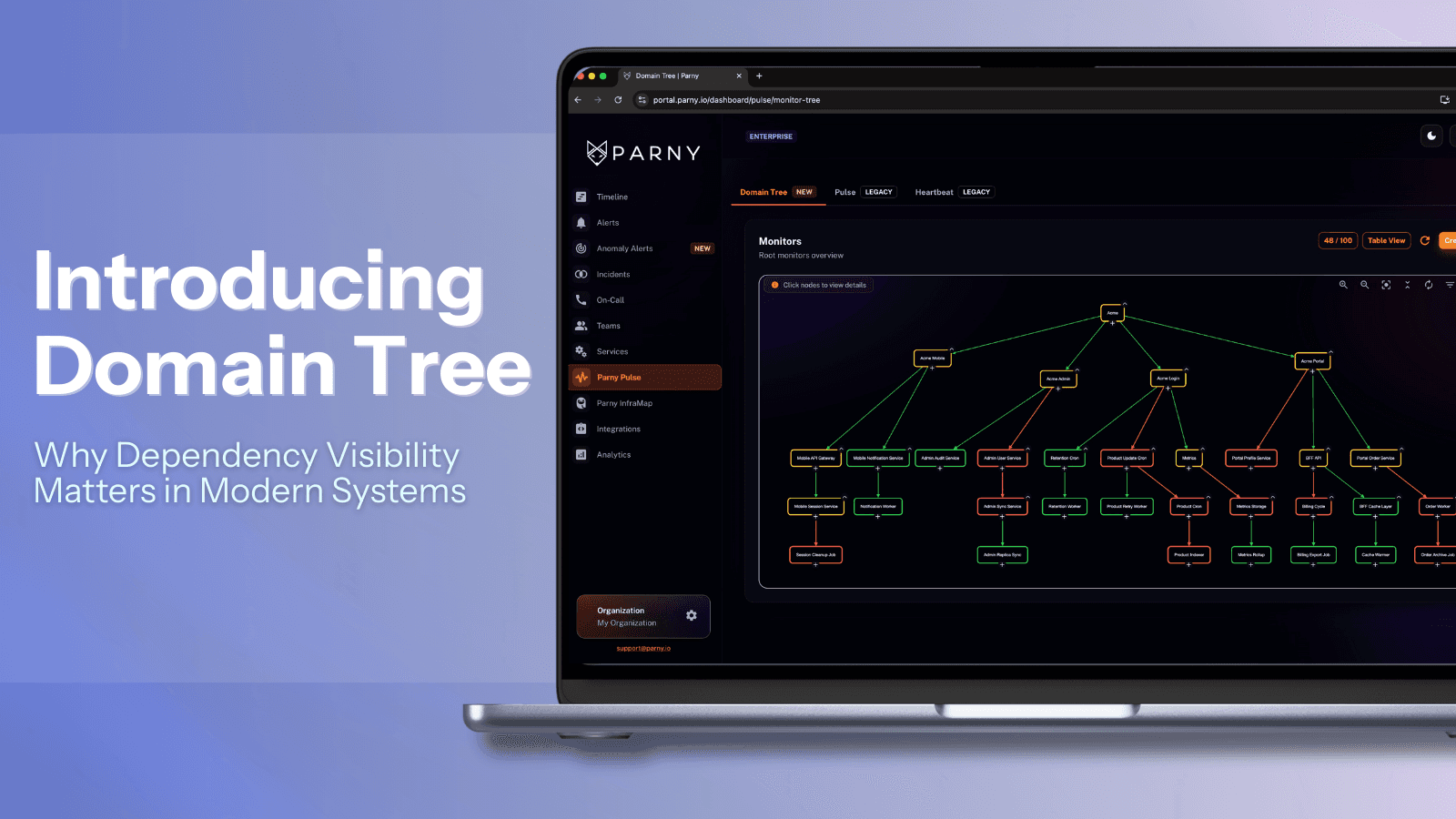
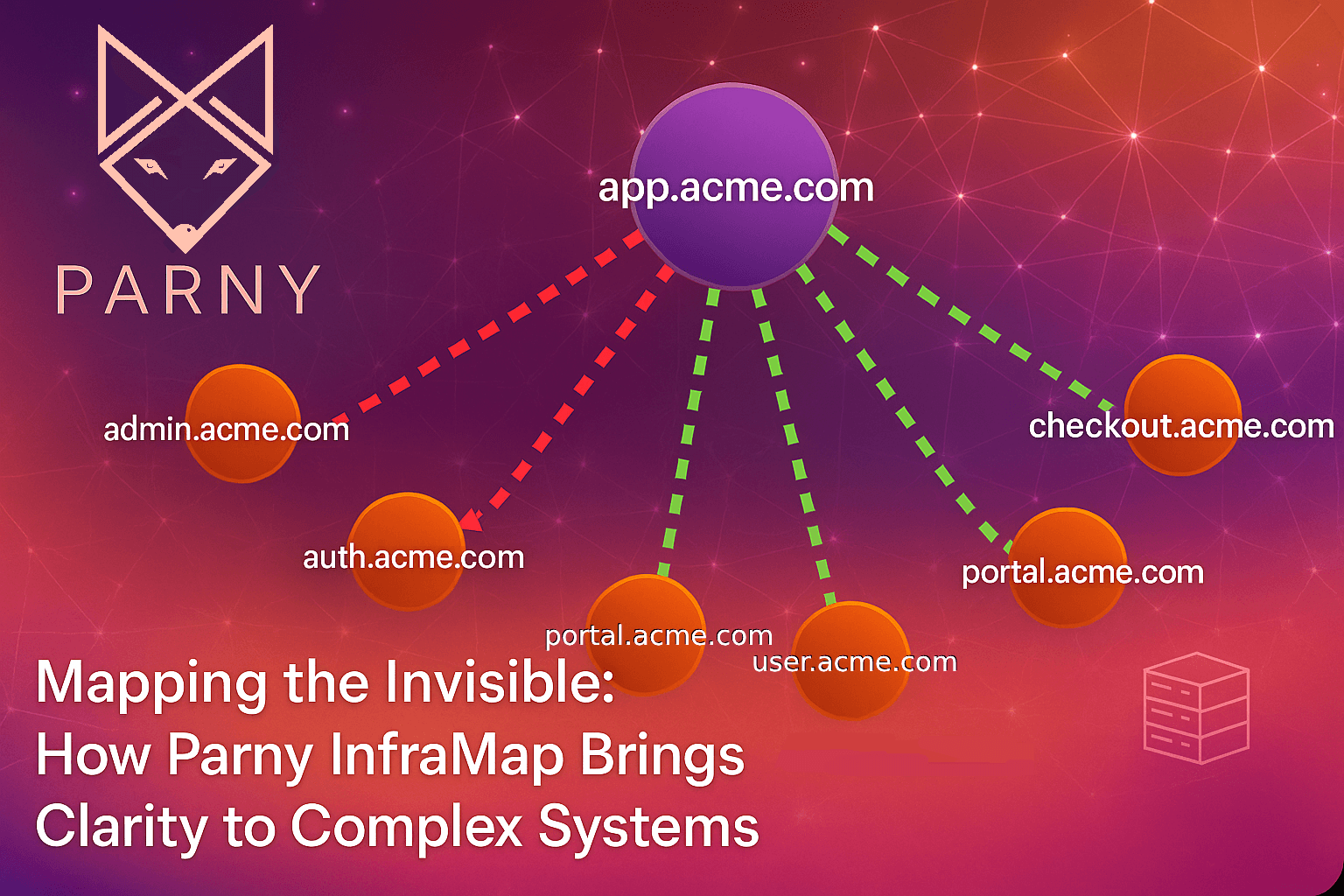
Parny ingests signals from monitoring tools and applies analysis that goes beyond forwarding or visualization. Through its service discovery capability, it automatically identifies applications and services operating within environments and models relationships between them. This produces a continuously updated dependency perspective reflecting system interactions.
Across infrastructure layers including servers, containers, services, and applications, Parny derives connection flows and interaction patterns. This allows teams to detect service disruptions or communication irregularities and better understand how behaviors propagate across dependencies.
From these analyses, teams are supported in:
identifying components likely affected by disruptions
narrowing potential origin points during investigation
Parny connects contextual insights with alert management and on call workflows so signals are delivered with relevant operational context attached. Routing decisions can therefore reflect system state rather than isolated alerts.
In practical terms, this positions Parny as a platform that helps transform monitoring signals into system level behavioral understanding, and contextual insight into coordinated operational response.
It does not attempt deterministic incident resolution.
Its objective is reducing investigative uncertainty and accelerating informed action.
Intelligence Layers and Search Visibility
As search ecosystems evolve toward semantic understanding and AI mediated discovery, technical content that accurately reflects operational reality gains increased relevance. Concepts such as DevOps practices, observability telemetry, AIOps correlation, and contextual dependency modeling form part of the knowledge graph that modern indexing systems evaluate.
Clear articulation of how these paradigms interact benefits both engineering communication and discoverability across AI driven search environments.
Producing technically grounded explanations that reflect real operational boundaries supports visibility without relying on exaggerated capability claims.
Operational Clarity Through Layered Thinking
Reliability at scale emerges from coordination between complementary layers:
DevOps enabling delivery velocity
Observability enabling behavioral visibility
AIOps enabling contextual interpretation
Treating these paradigms as replacements oversimplifies modern infrastructure management. Viewing them as cooperative layers reflects the operational structure engineering teams work within daily.
As distributed systems continue to grow in complexity, the ability to construct context across signals, dependencies, and response pathways remains central to maintaining stability.
This is where contextual intelligence contributes measurable value today, and where platforms designed to interpret operational environments continue to evolve alongside the systems they observe.