
And Why Parny AI Is Becoming the Missing Layer of Incident Response
Modern infrastructure is extremely good at detecting problems.
Most engineering teams already run a mature monitoring stack. Metrics platforms track system performance, alerting rules fire when thresholds are crossed, logs capture every detail of what happens inside services, and incident management tools help coordinate responses.
Detection, in other words, is not the problem anymore.
Yet when a production incident begins, something surprising still happens. Even with all these tools in place, teams often spend the first fifteen or twenty minutes trying to answer very basic questions. What does this host actually do? Which services depend on it? Is this failure affecting users yet, or is it still isolated? And perhaps the most important question of all: is this the real problem, or just a symptom of something deeper in the infrastructure?
The alert itself rarely answers these questions.
Instead, engineers start jumping between dashboards, digging through logs, opening service maps, and trying to mentally reconstruct the architecture of the system. They are essentially rebuilding the dependency graph of the infrastructure in their heads.
This is where incident response slows down. And it is where most monitoring tools reach their limits.
Monitoring is very good at telling you that something is wrong. What it cannot easily tell you is what that failure actually means for the rest of the system.
Consider a typical alert. A monitoring platform might report that a specific host is not responding. From a technical perspective, that statement is correct. But from an operational perspective, it is incomplete. Engineers still need to understand which service pools rely on that host, what traffic flows through it, and whether customer-facing APIs or domains depend on it. They also need to determine whether this alert is an isolated problem or part of a broader incident.
Answering these questions requires context about the infrastructure. And gathering that context is usually a manual process.
Parny AI was built to close this gap.
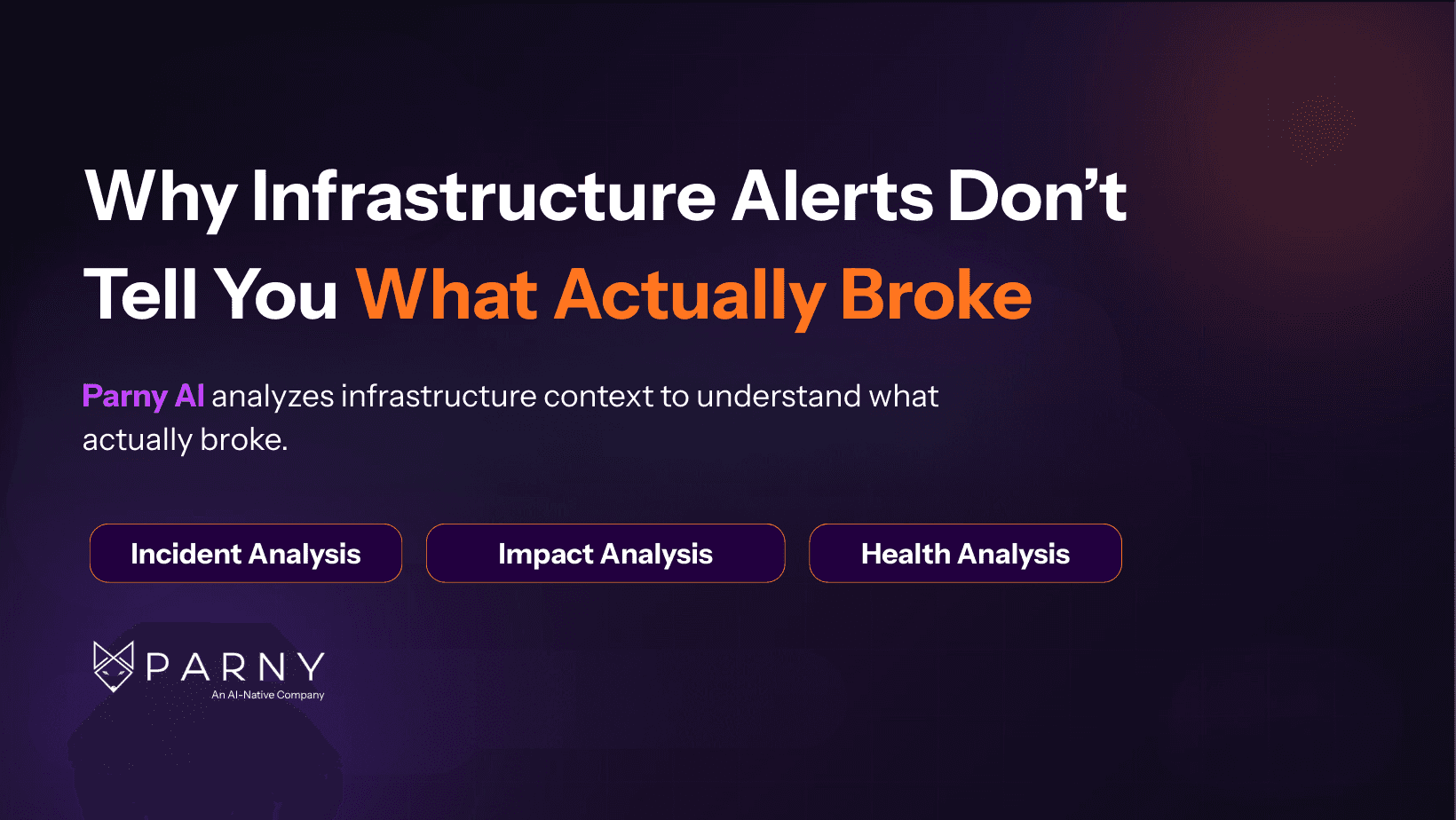
Instead of treating alerts as isolated signals, Parny AI analyzes them in the context of the entire infrastructure. The system continuously understands how services are connected through service discovery, dependency mapping, and infrastructure topology data. When an alert fires, it does not simply forward the notification. It evaluates how that event interacts with the rest of the system.
This allows Parny AI to determine which services depend on the affected host, which domains or APIs may be impacted, and whether multiple alerts are actually connected to the same underlying failure. Rather than producing another notification, the platform generates a structured impact analysis.
At a high level, the analysis process follows a simple sequence. An alert triggers the evaluation. The infrastructure is automatically discovered and mapped. Dependencies between services are analyzed. Parny AI then evaluates the situation and produces an executive summary explaining what is happening in the system.
The goal is not just to detect incidents. It is to turn alerts into operational understanding.
This shift becomes particularly valuable when multiple alerts fire at the same time. In complex infrastructures, incidents rarely appear as a single signal. Several alerts may trigger simultaneously across different hosts or services. Without context, teams often investigate these alerts separately, even when they originate from the same root cause.
Parny AI approaches the problem differently. By analyzing alerts alongside the infrastructure dependency graph, it can determine whether incidents are correlated or independent. Shared infrastructure components such as databases, caches, or authentication services are identified automatically. Related alerts can be grouped together, while unrelated signals are separated into different incident clusters.
The result is a much clearer picture of what is actually happening inside the system.
This context also enables another critical capability: understanding the blast radius of an incident. When a host fails, the most important question is rarely the host itself. The real concern is which services, applications, or domains depend on it. Parny AI evaluates upstream and downstream relationships between services and identifies which parts of the infrastructure may be affected.
Instead of forcing engineers to manually trace these connections, the system provides an immediate explanation of the potential impact.
For example, rather than simply reporting that a Redis instance is experiencing errors, the platform might produce a summary explaining that the Redis cache pool is critical and that several application services relying on it are likely to be affected. It may also suggest that memory pressure is the probable cause of the failure. This type of analysis allows teams to move directly into resolution mode instead of spending valuable time investigating the system structure.
Different teams benefit from this kind of context in different ways. NOC and L1 operations teams gain immediate clarity about what happened and which services are affected. DevOps and SRE engineers receive a ready-to-use map of service dependencies for root cause analysis. Platform engineering teams gain deeper visibility into infrastructure relationships, while IT leadership benefits from concise executive summaries that accelerate decision-making during incidents.
According to the system architecture, Parny AI can analyze more than one hundred hosts within a single evaluation and produce results in under thirty seconds.
This speed is critical during real incidents, when every minute spent understanding the problem delays the resolution.
Monitoring systems will continue to generate alerts. That part of operations tooling is already well established. The real challenge is interpreting those alerts in the context of increasingly complex infrastructures.
As distributed architectures grow and service dependencies multiply, manual incident reasoning becomes harder and more fragile. Engineers should not have to reconstruct their entire infrastructure every time an alert fires.
The next evolution of incident response tools will focus on one fundamental capability: turning infrastructure signals into actionable operational intelligence.
That is precisely the problem Parny AI is designed to solve.
Parny AI is currently available in closed beta. Teams that want early access to infrastructure-aware incident analysis can join the waitlist at https://parny.io/parny-ai.
Because the next time your infrastructure fires an alert, the real question is not whether you will detect the problem.
The real question is whether your team will still be digging through dashboards to understand it, or whether Parny AI will already know what actually broke.