
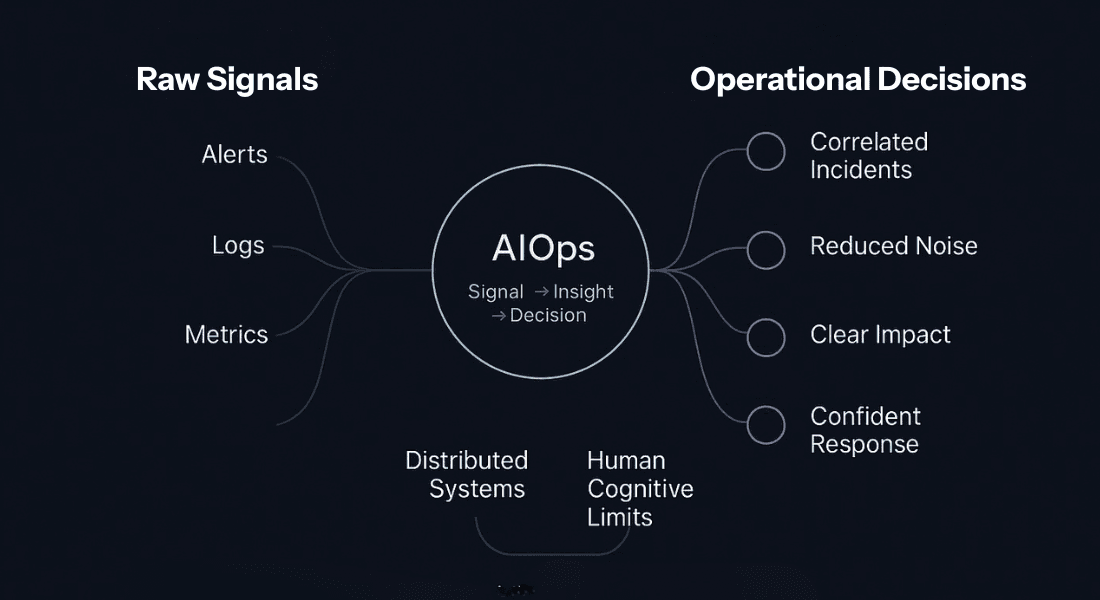
AIOps stands for Artificial Intelligence for IT Operations a modern approach that applies machine learning and analytics to help teams make sense of the massive amount of data produced by today’s systems. AIOps exists because modern systems generate more signals than humans can interpret in real time.
Instead of treating alerts, logs, traces, and metrics as isolated events, an AIOps platform analyzes them holistically to uncover patterns, detect anomalies, identify likely root causes, and guide teams toward the next best action.
In simple terms:
Monitoring tells you something is broken.
Observability helps you explore why it happened.
AIOps goes further it connects the dots, filters the noise, prioritizes what matters, and accelerates how quickly teams respond.
Why Monitoring and Observability Are No Longer Enough
Modern IT environments are:
highly distributed
dynamic and constantly changing
made up of dozens (or hundreds) of interconnected services
producing millions of signals every day
Monitoring tools trigger alerts when something goes wrong. Observability platforms reveal deeper context. But both still rely heavily on human interpretation.
Teams often find themselves:
Switching between many tools to assemble context
Manually grouping alerts into a coherent incident
Guessing which signal represents the true root cause
Debating who should respond
Struggling to communicate impact across teams
This workflow breaks down quickly as systems scale.
The result is predictable:
alert fatigue
slow, inconsistent triage
recurring incidents without clear patterns
burnout among on-call engineers
missed SLOs and reliability targets
This is why AIOps has shifted from a “nice idea” to a critical requirement for modern engineering teams.
How AIOps Works at a High Level
A mature AIOps platform operates across four essential layers:
1. Collect
It ingests data from across your entire technology stack monitoring alerts, logs, metrics, traces, dependency graphs, CI/CD change events, and historical incidents forming a unified real-time understanding of system behavior.
2. Understand
Using machine learning and advanced analytics, AIOps detects anomalies, identifies repeated patterns, clusters related alerts, understands service dependencies, and turns raw data into meaningful signals.
3. Decide
It prioritizes incidents by impact, highlights probable root cause candidates, identifies the right responders, and recommends investigation paths cutting through noise and uncertainty.
4. Act
AIOps then supports or automates actions such as creating enriched incidents, routing alerts to the correct team, updating collaboration channels, or triggering safe remediation workflows.
Teams can adopt automation gradually, starting with decision support and expanding into full remediation when ready.
Real-World Use Cases You Will Recognize
Reducing Alert Noise
Instead of hundreds of scattered alerts, AIOps groups related signals into a single enriched incident dramatically reducing fatigue and helping teams stay focused.
Faster Root Cause Analysis
By correlating signals across services, AIOps quickly surfaces the likely source of failure, such as a single database node triggering widespread downstream errors.
Protecting SLOs Before They Break
AIOps continually monitors key service indicators and predicts when an incident is trending toward an SLO breach enabling earlier intervention.
AI-Assisted Investigation
Some platforms provide AI-powered recommendations, guiding engineers through investigation steps or remediation ideas, especially helpful for less experienced on-call responders.
When Your Team Actually Needs AIOps
Your team is ready for AIOps if:
You use monitoring + observability but still drown in alerts
You operate many interconnected services
Incidents routinely cross team or domain boundaries
Your on-call engineers experience fatigue or burnout
You want faster, more reliable, and more confident incident response
You have a lot of data but not enough clarity
Put simply:
If you’re rich in signals but poor in insight, AIOps is the next logical step.