
Engineering teams today do not struggle because they lack data.
They struggle because everything has become data.
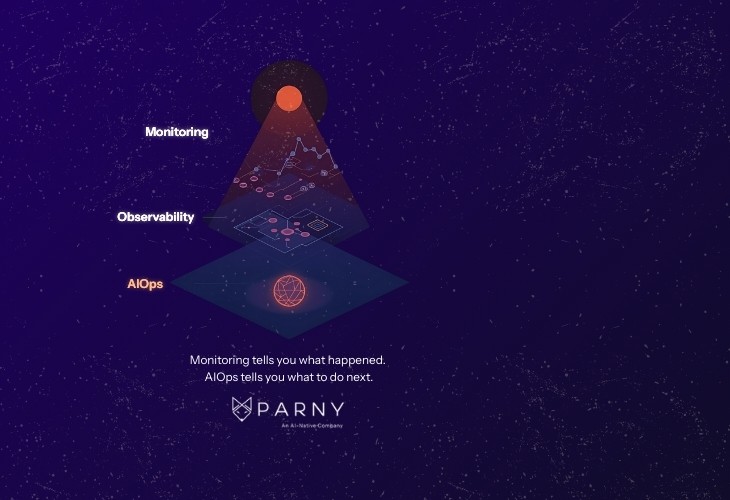
Monitoring tells you what broke.
Observability helps you understand why it broke.
But neither, on its own, delivers real-time understanding during high-pressure incidents.
Modern environments are distributed, ephemeral, and interconnected across dozens of services. Signals multiply. Dashboards fragment. Context disappears.
And during incidents, teams face a single painful truth:
Signals are easy. Understanding is hard.
This reality is pushing engineering organizations toward the next stage of operational maturity:
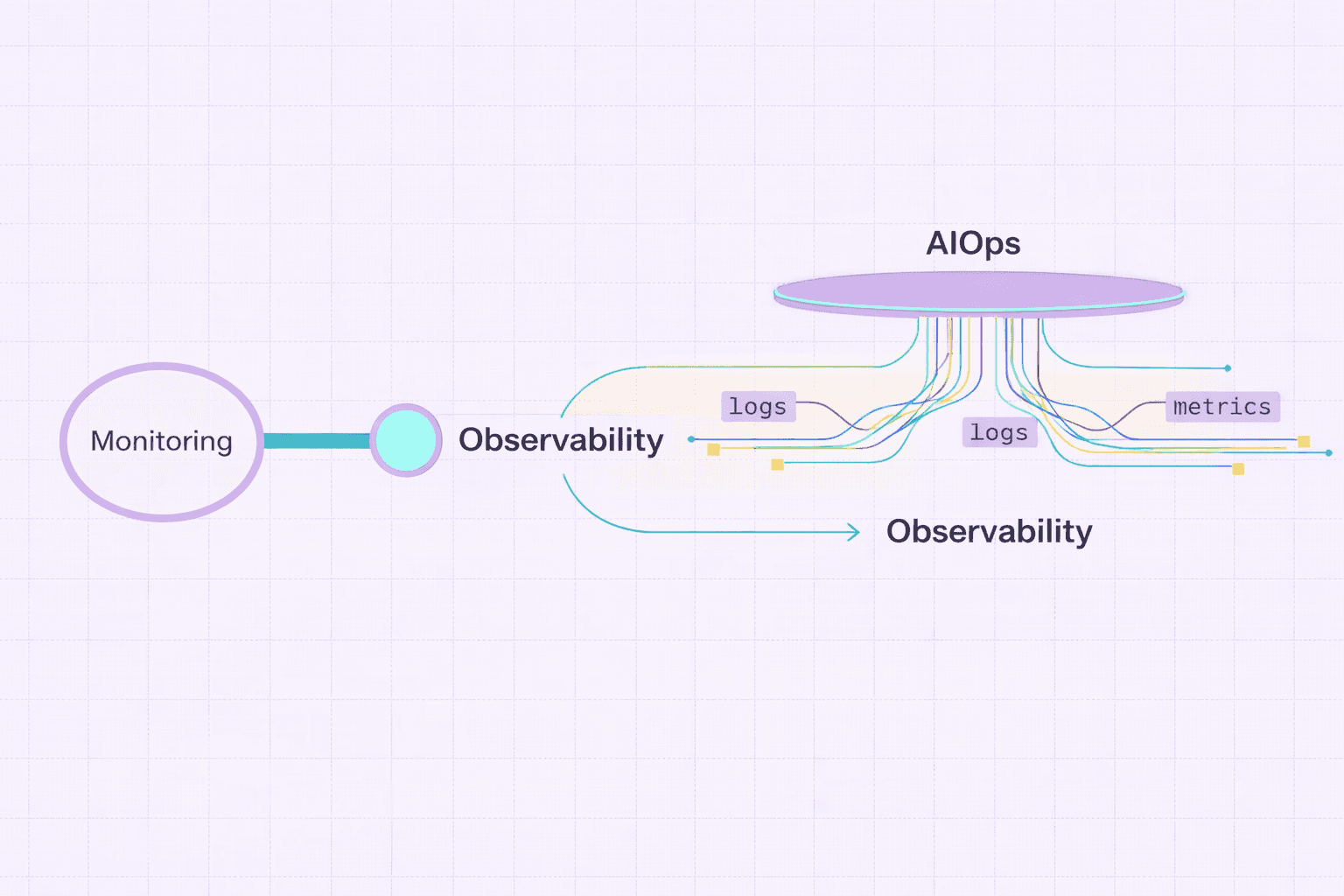
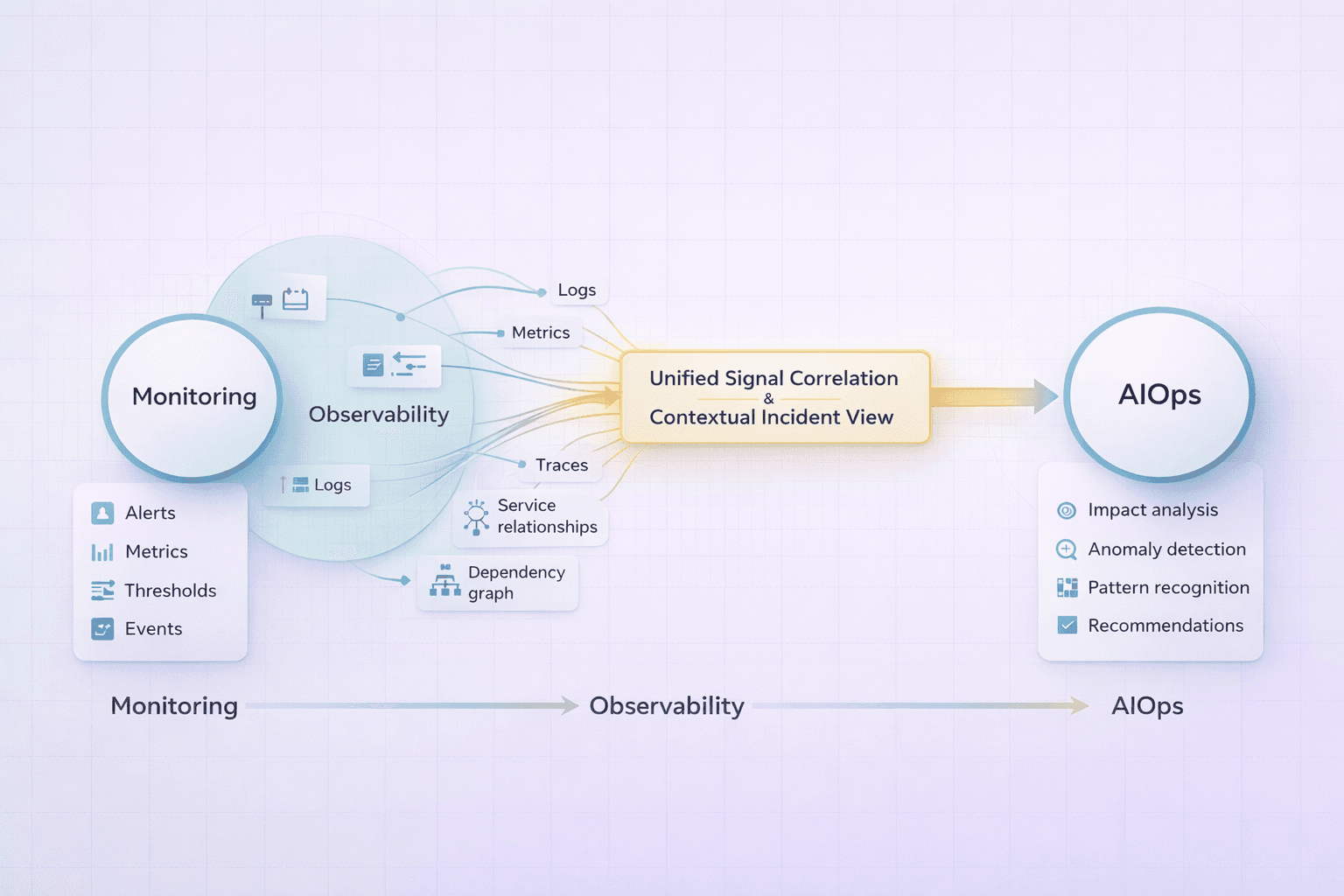
Monitoring → Observability → AIOps
Parny’s perspective on this evolution is intentional.
We are not a full AIOps platform today.
In 2026, we will be, built on architecture that supports real AIOps, not cosmetic automation.
This article breaks down the full journey, explains why teams get stuck along the way, and outlines how Parny is building the foundation required for true AIOps.
1. Why the Journey From Monitoring to AIOps Matters
AIOps has become a buzzword, but the progression behind it is real.
Engineering teams evolve along a predictable path:
Monitoring detects symptoms.
Observability explains causes.
AIOps interprets meaning and recommends action.
Understanding this sequence matters. Skipping steps does not accelerate maturity. It creates fragile systems that collapse under pressure.
2. What Is Monitoring? Answering “What Happened?”
Monitoring is the foundation of reliability engineering. It surfaces:
What broke
When the signal started
How severe it appears
Monitoring captures the spark, but it cannot describe the fire.
Dashboards turn red. Alerts fire.
Yet in distributed systems, knowing what happened is only the first step and often the least useful one during an incident.
Monitoring shows symptoms. Understanding requires context.
3. What Is Observability? Answering “Why Did It Happen?”
Observability expands the operational view using logs, metrics, traces, events, and topology relationships. It helps teams understand:
Why the issue occurred
Which service is responsible
How the problem propagated
What else is impacted
Despite its power, context stitching remains manual.
During incidents, teams jump between dashboards, pivot across tools, correlate logs and traces, and attempt to reconstruct reality under pressure.
Modern systems easily exceed human cognitive limits.
Observability improves insight, but it does not solve the need for real-time interpretation.
4. What Is AIOps? Turning Signals Into Decisions
AIOps aims to answer a different question:
What does this mean, and what should we do next?
It promises:
Automated multi-signal correlation
Prioritization based on real user impact
Early anomaly detection
Faster and more confident decision-making
Actionable operational understanding
But here is the problem.
Most AIOps initiatives fail because the underlying data is not ready for intelligence.
True AIOps requires:
Clean and normalized signals
Real-time dependency mapping
Consistent metadata
Accurate directional relationships between services
Without this foundation, AIOps becomes a noisy black box.
This is the architectural gap Parny is intentionally solving.
5. Why Most AIOps Attempts Fail Today
AIOps is not difficult because AI is hard.
AIOps is difficult because context is missing.
Failures happen when:
Alerts are fragmented across tools
Dependencies are unknown or outdated
Data is inconsistent or duplicated
Topology is inferred manually
Incidents lack a unified operational story
AIOps cannot correlate what it cannot understand.
Before automation, teams need clarity.
This is where Parny sits, between observability and AIOps.
6. Where Parny Fits: The Missing Clarity Layer Between Observability and AIOps
Parny provides the architectural prerequisites AIOps needs to succeed.
6.1 Unified Alert Intelligence
Parny normalizes alerts from all sources into:
A single coherent incident
Noise-reduced and deduplicated signals
Grouped alerts mapped to affected services
Alerts stop being streams. They become stories.
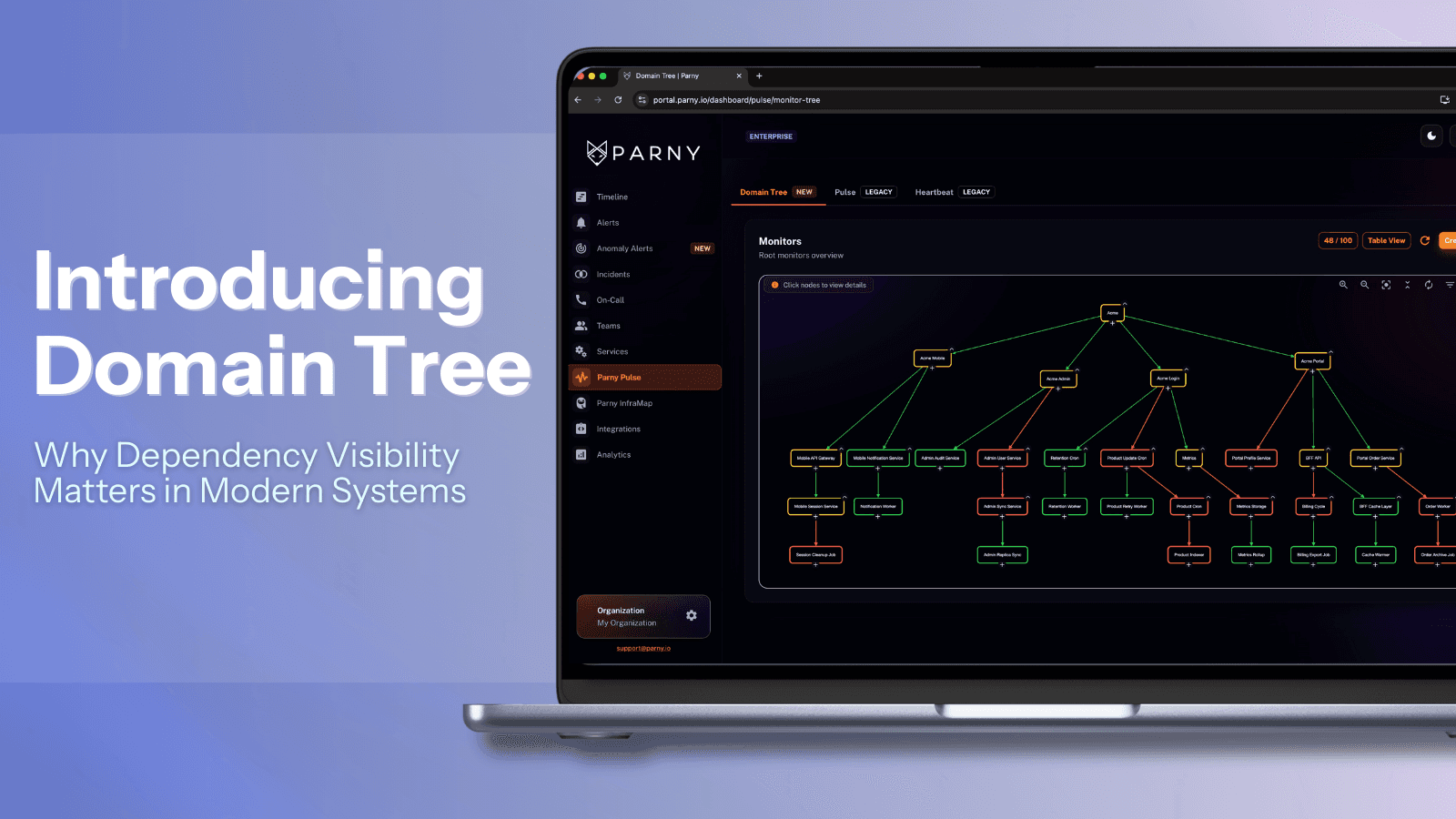
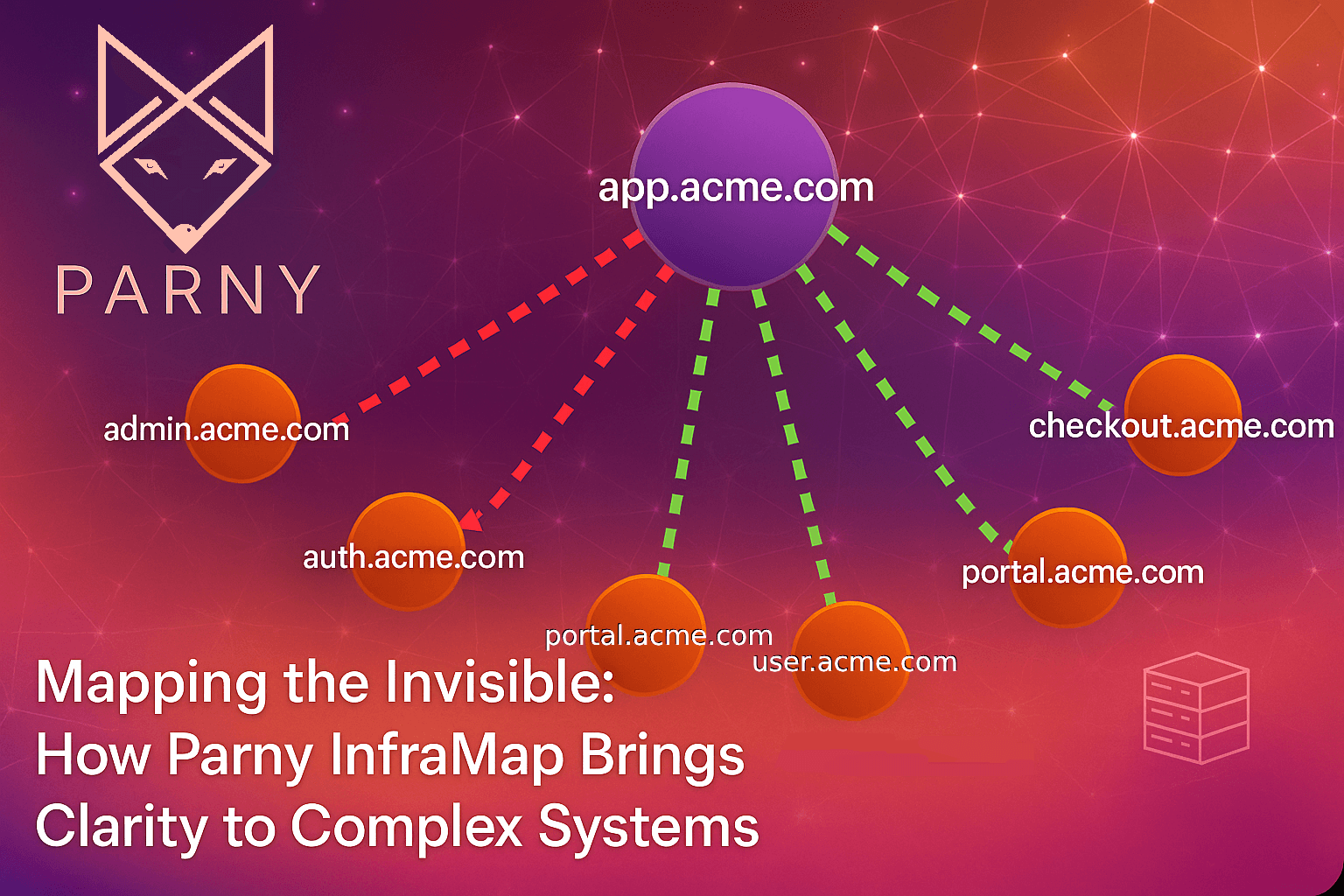
6.2 Real-Time Dependency Mapping (InfraMap and Domain Tree)
Parny automatically discovers:
Services
Databases
Queues
APIs
Ingress and egress paths
Directional relationships
This real-time dependency graph is the backbone of future AIOps correlation and impact analysis.
6.3 Contextual Incident View
Inside Parny, every incident becomes a structured operational narrative.
Teams can instantly see:
Which services are impacted
How dependencies cascade
What changed before the incident
Historical patterns and similar incidents
These are not AIOps features.
They are AIOps foundations.
Today, Parny delivers clarity.
Tomorrow, this clarity enables intelligence.
7. Parny’s Roadmap to AIOps (2024 to 2026)
AIOps is not a feature. It is a progression.
Phase 1: Signal-Level Intelligence
Notifying the right person at the right time.
Alert unification
Dependency visibility
Topology-based grouping
Baseline correlation
This phase transforms chaos into a coherent operational picture.
Phase 2: Automated Understanding
In 2025, Parny evolves from visibility to interpretation:
Pattern recognition across services
Root-cause path insights
Impact-based prioritization
Early anomaly detection
Automatic dependency discovery
Teams begin to see not only what broke, but what is likely to break next.
Phase 3: Full AIOps
By 2026, Parny becomes a true AIOps platform with:
Predictive incident behavior
Automated multi-signal correlation
Intelligent alert routing
Proactive remediation suggestions
Autonomous impact analysis
These are architectural milestones, not aspirational promises.
8. Why Teams Benefit Long Before AIOps Arrives
Operational pain today is driven by:
Alert noise
Fragmented tools
Missing context
Manual correlation
Unknown dependencies
Cognitive overload
Parny addresses these challenges by delivering:
Faster MTTA and MTTR
Real-time service relationships
Unified incident understanding
Clearer on-call workflows
Reduced alert fatigue
A shared operational picture for engineering, product, and business teams
Clarity is the multiplier.
AIOps amplifies clarity. It does not replace it.
9. Start Your Monitoring to AIOps Journey with Parny
Engineering teams preparing for AIOps need the right foundations today.
Teams can start today:
Try Parny Freemium and explore InfraMap, Domain Tree, and unified incidents
Request a demo to see how Parny fits into your reliability stack
Run a PoC to measure improvements in MTTA, MTTR, and noise reduction
Parny brings understanding where monitoring ends.
Parny brings intelligence where observability stops.
The journey has already begun.