For years, infrastructure operations have been designed around one basic assumption: when something goes wrong, the first priority is to notify the right person.
That assumption made sense when monitoring environments were smaller, dependencies were easier to understand, and operational teams worked with a limited number of tools.
It is no longer enough.
Modern infrastructure generates signals from monitoring platforms, cloud services, applications, network systems, containers, virtual machines, and incident management tools. Most organizations already have systems capable of detecting anomalies and delivering alerts.
The real operational problem now begins after the notification.
An alert may tell the team that CPU usage has increased, a service has stopped responding, or a threshold has been exceeded. It rarely explains why the issue happened, which services are affected, how far the impact may spread, or what the team should investigate first.
This is why treating operations as a notification problem is outdated.
Alerts create awareness, not understanding
A notification is only the first signal that something may require attention.
From that point, operations teams still need to answer several questions:
What changed before the issue started?
Which systems or services are affected?
Is the alert a symptom or the actual source of the problem?
How are the affected components connected?
What is the likely blast radius?
Which action should the team prioritize?
In many organizations, these answers are still assembled manually.
Engineers move between dashboards, review logs, compare timelines, check recent deployments, inspect service dependencies, and contact other teams for context. The alert is delivered instantly, but understanding the incident can still take a significant amount of time.
This gap between detection and understanding is where much of the operational delay occurs.
More notifications do not create better operations
When incident response is built mainly around alert delivery, the natural response to operational problems is often to add more notifications.
Teams introduce additional thresholds, more escalation rules, new channels, and further integrations. This may improve visibility, but it does not necessarily improve decision-making.
In some cases, it makes the operating environment harder to manage.
More alerts can lead to:
duplicated signals
fragmented incident context
unclear ownership
longer triage cycles
unnecessary escalations
alert fatigue
inconsistent response quality
The issue is not that teams lack signals. The issue is that those signals are not converted into a coherent operational picture.
A notification-first model optimizes for message delivery.
A modern operations model should optimize for understanding and action.
The operational bottleneck has moved
Monitoring tools have become effective at detecting deviations. Alerting platforms can route incidents quickly. Collaboration tools can bring teams together within seconds.
The main bottleneck is no longer whether someone receives the alert.
It is whether the team can understand the situation quickly enough to act with confidence.
This changes the role of operational intelligence.
Instead of asking only, “Who should receive this alert?”, teams need to ask:
What happened?
What changed?
What depends on the affected component?
Is this part of a wider incident?
What should be investigated first?
This is the point where infrastructure intelligence becomes more valuable than another notification layer.
How Parny AI changes the operational workflow
Parny AI works on top of the existing monitoring, alerting, observability, and incident management stack.
It does not replace these systems. It uses the signals they already produce and turns them into operational context.
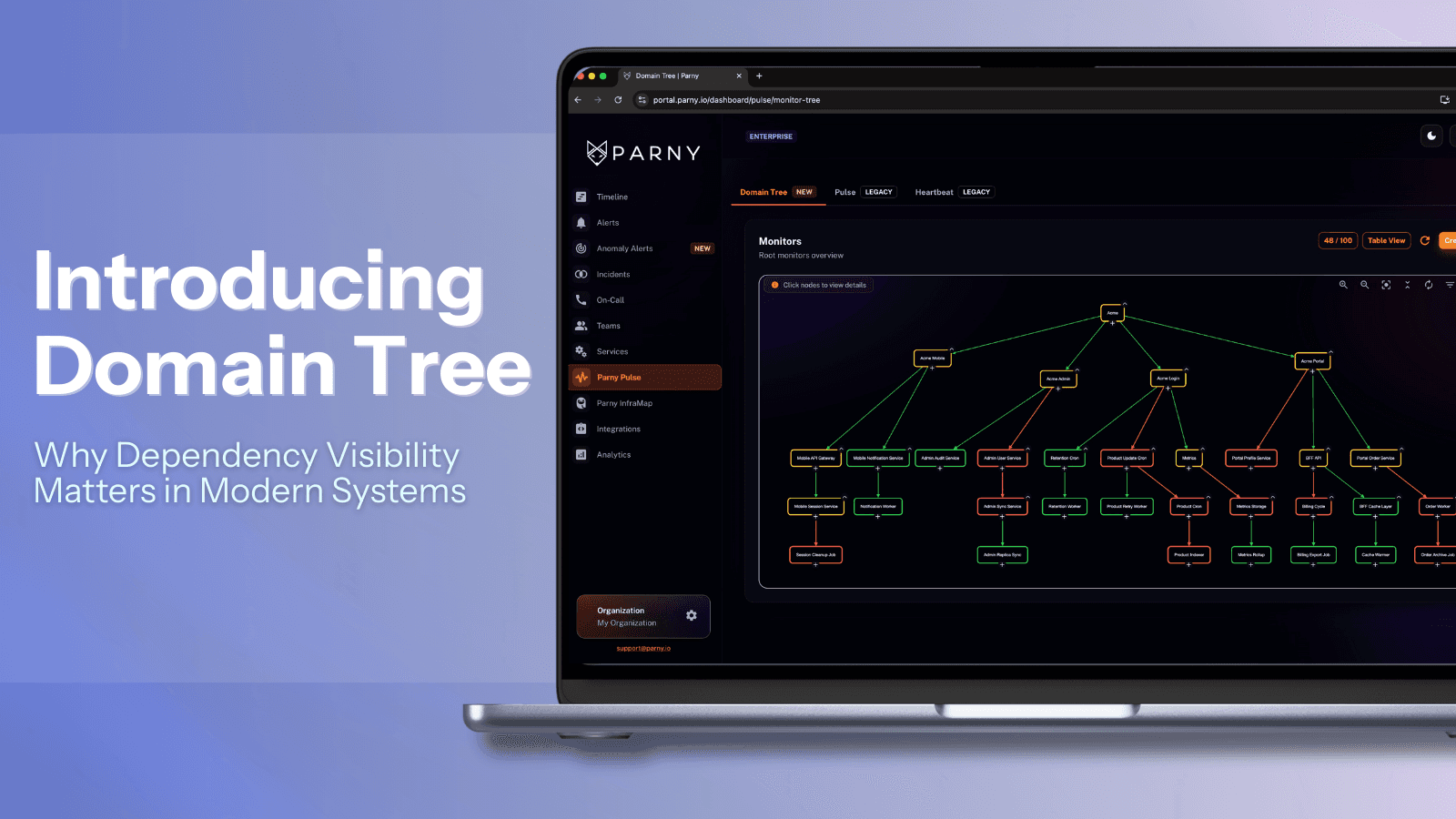
Instead of presenting another isolated alert, Parny AI helps teams understand the relationship between changes, infrastructure components, dependencies, and impact.
This changes the workflow from:
Alert received → manual investigation → context gathering → escalation → action
to:
Signal detected → context generated → impact understood → investigation prioritized → action
The difference is not cosmetic. It changes how teams use their time during incidents.
From signal collection to operational context
Parny AI brings together infrastructure signals and analyzes them in relation to the surrounding environment.
This allows teams to move beyond the alert itself and examine the broader operational situation.
The generated context can include:
What changed
Incidents often begin with a change, even when the first visible symptom appears elsewhere.
A deployment, configuration update, service restart, infrastructure change, or dependency failure may trigger a chain of downstream effects.
Parny AI helps surface relevant change signals so teams can evaluate what happened before the incident became visible.
What is affected
An alert usually refers to a specific component. The actual impact may extend across services, applications, infrastructure layers, or business processes.
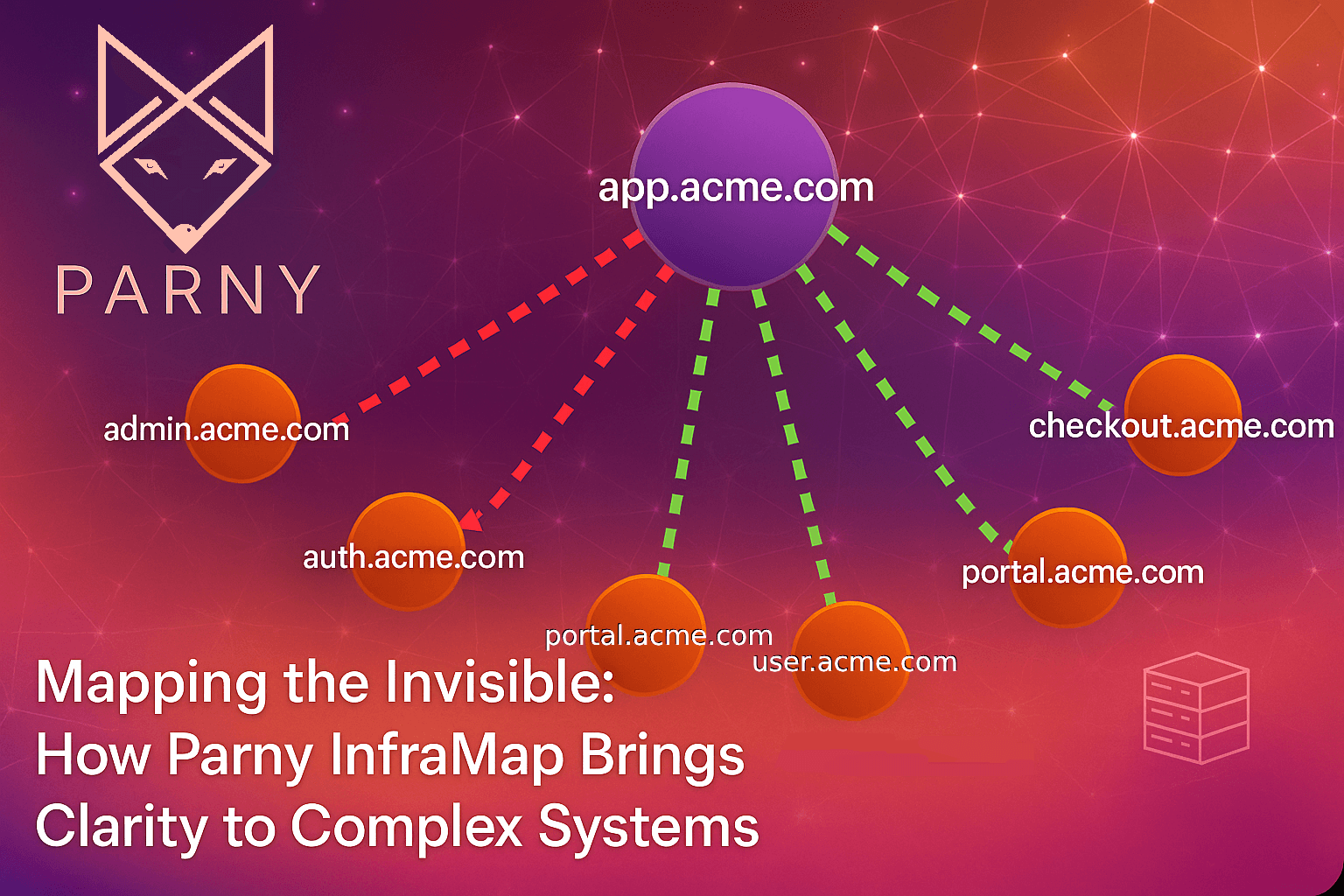
By mapping dependencies and service relationships, Parny AI helps teams understand which systems may be affected and which areas should be checked first.
How far the impact may spread
Not every alert represents the same level of operational risk.
A single component issue may remain isolated, or it may affect several dependent services. Understanding the probable blast radius helps teams prioritize incidents more accurately and avoid unnecessary escalation.
What the probable root cause may be
Parny AI does not treat every alert as an independent event.
It correlates signals, dependencies, and changes to help teams identify the most probable source of an issue.
This reduces the time spent investigating symptoms that originate from the same underlying problem.
What the team should do next
Operational context is only valuable when it helps teams make decisions.
Parny AI provides recommended next actions based on the available infrastructure signals and incident context. These recommendations help teams decide where to begin, which component to inspect, and which response path is likely to be most relevant.
The impact on business processes
The value of infrastructure intelligence is not limited to engineering efficiency.
When incident response becomes faster and more consistent, several business processes improve with it.
Faster triage and lower time to resolution
Manual triage is one of the most time-consuming stages of incident response.
Teams often spend the first part of an incident determining whether multiple alerts are related and which one represents the actual source of failure.
By providing impact, change, dependency, and probable cause context earlier, Parny AI reduces the amount of manual investigation required before action begins.
This can shorten mean time to acknowledge and mean time to resolution, especially in environments where incidents cross multiple services or teams.
Better use of engineering capacity
Senior engineers are frequently pulled into incidents because the available context is incomplete.
When L1 or L2 teams cannot determine impact or probable cause, escalation becomes the safest option. This creates unnecessary interruption for experienced engineers and increases operational cost.
Parny AI helps standardize the context available at the beginning of an incident.
This allows frontline teams to investigate more effectively and gives senior engineers a clearer starting point when escalation is necessary.
The result is not the removal of human expertise. It is a more efficient use of that expertise.
More consistent incident response
Incident quality often depends on who is on call.
Experienced engineers may know where to look, which dependencies are critical, and which changes are likely to matter. Less experienced team members may need more time to reach the same conclusion.
By presenting infrastructure context in a structured way, Parny AI reduces the dependency on individual memory and tribal knowledge.
This creates a more consistent response process across shifts, teams, and experience levels.
Stronger cross-team coordination
Infrastructure incidents often involve more than one team.
Application, infrastructure, platform, network, security, and database teams may all become involved. Without clear context, each team may investigate its own area independently.
This creates duplicated work and slows coordination.
A shared view of affected services, dependencies, change signals, and probable impact gives teams a common operational picture.
Instead of debating which alert matters most, teams can focus on the same incident context and coordinate around evidence.
Better prioritization
Not every alert requires the same level of response.
Some incidents affect a single internal service. Others may threaten customer-facing systems or critical business processes.
Notification-based workflows often prioritize incidents using static severity rules. These rules may not reflect the actual business or infrastructure impact.
Parny AI adds dependency and impact context, allowing teams to assess incidents based on what is affected rather than only on which threshold was crossed.
This leads to more accurate prioritization and more rational allocation of engineering resources.
Reduced operational noise
Alert noise is not only a monitoring problem. It is also a context problem.
When several alerts describe different symptoms of the same underlying incident, teams may treat them as separate events.
Parny AI correlates related signals and helps teams understand them as part of a broader operational situation.
This reduces duplicated investigation and prevents teams from responding to every alert in isolation.
Improved operational continuity
Faster response, clearer ownership, and more consistent decision-making reduce the operational disruption caused by incidents.
This matters beyond IT.
Infrastructure failures can delay internal processes, affect customer experience, interrupt digital services, and consume management attention. The longer teams spend identifying the issue, the longer those business processes remain exposed.
By shortening the path from signal to action, Parny AI supports operational continuity at both the technical and organizational level.
Existing tools remain essential
Moving beyond notification-first operations does not mean monitoring, observability, or incident management tools are no longer necessary.
These systems remain critical.
Monitoring tools detect conditions. Observability platforms provide data. Incident tools manage escalation and coordination. Collaboration systems bring teams together.
The missing layer is often the interpretation of those signals.
Parny AI operates at this layer.
It uses the existing stack rather than forcing teams to replace it. This makes it possible to improve incident intelligence without rebuilding the entire operational environment.
Operations should be designed around decisions
A notification tells the team that something happened.
Operational intelligence helps the team understand what it means.
That distinction is becoming increasingly important as infrastructure grows more distributed and interconnected.
The next generation of operations will not be defined by how quickly an alert reaches a channel. It will be defined by how quickly teams can understand the incident, assess the impact, and take the right action.
Treating operations as a notification problem was reasonable when the main challenge was visibility.
Today, the real challenge is context.
Parny AI helps close that gap by turning infrastructure signals into information teams can use to make faster and more consistent operational decisions.
Because sending another alert is easy.
Giving the team enough context to act is the part that matters.