PagerDuty helped define modern on-call. Its scheduling is mature, its integration catalog is the widest on the market, and its incident workflows have fifteen years of enterprise use behind them. But paging the right person is now the easy part. The moment they pick up, they still have to work out what broke, why, which services are affected, how far it spreads and what to do first. Paging answers none of that.
That gap is the whole comparison. PagerDuty sells the answers as separate products you add on top of paging. Parny builds them in, because for Parny they are the product. Parny is a global AIOps platform for SRE, DevOps, Platform Engineering and IT Operations teams, working as an SRE intelligence layer over the monitoring, observability and incident tools you already run. It combines those signals with its own infrastructure data and a live service-dependency graph, then turns the result into something a responder can act on.
Both platforms have AI. The real question is whether that intelligence is a separate SKU you buy after on-call, or the core of the product with on-call included.
The short version
Parny and PagerDuty answer two halves of an incident. PagerDuty is the mature on-call platform: it pages the right person, and you add AIOps, status pages and automation as separate products. Parny is an AIOps platform that pages people too, then tells them what broke, why, which services are affected and what to do next, with that intelligence included rather than sold separately.
Pick PagerDuty for the most mature, battle-tested on-call scheduling and the widest integration catalog (750+). Pick Parny for automatic infrastructure topology, built-in monitoring and root-cause diagnosis, priced as a per-user plan plus per-asset Parny AI, which at list prices runs roughly $1,238/mo less than the equivalent PagerDuty stack for a 50-engineer team monitoring only a few assets.
And if you only want on-call? That works too. Parny is an AIOps platform, but you don't have to buy the whole idea on day one. Basic is a straight on-call and incident management plan rotations, escalation policies, call/SMS/push/email, timeline, analytics at $16/user/mo, with no AIOps line item attached. Teams that want the diagnosis layer move up to Premium and turn on Parny AI. Same platform, same data, one upgrade away. You start where your team actually is.
At a glance
Criterion | Parny | PagerDuty |
|---|---|---|
Alert intelligence (grouping, noise reduction, false-positive detection) | Included in Premium on-call | Separate AIOps SKU, consumption-based, from $699/mo |
Live infrastructure topology (dependency map) | Service Discovery and InfraMap, mapped automatically in real time | Not available (manually-modeled service relationships only) |
Built-in monitoring (infra + database) | Agent-based: CPU/mem/disk plus slow and anomalous query detection, anomaly-alerted | None; routes alerts in from other tools |
Anomaly detection and predictive root cause | RCF-based, included | Correlation only, no RCA |
Status pages | Included | $89/mo add-on |
On-call scheduling depth | Parny Shift smart scheduling, Swap, On-Call Rules, multi-level Escalation Policies, Call/SMS/Push/Email (Slack & Teams via integrations), Timeline and Analytics | Deepest and most mature, 15 years |
Integrations | Growing, key stack covered | 750+, widest in market |
Pricing model | Per-user plan plus per-asset Parny AI, alert intelligence included | Per-user plus 4 separate add-on SKUs |
1. On-call and incident management
On-call is where you'd expect PagerDuty to walk it, and on sheer maturity it still leads: fifteen years of enterprise use have hardened its scheduling for the gnarliest edge cases. But this isn't a category where Parny is thin.
Parny's on-call is modern and full-featured. Parny Shift auto-generates rotations with smart scheduling, balancing weekday and weekend load fairly across the team rather than letting it land on whoever forgot to swap, and Swap hands a member's shifts to one or more teammates in a click. On-Call Rules decide who gets notified and how, filtering alerts by text, regex, tag or SLA, and Escalation Policies move an unacknowledged alert up the levels (L1 to L2 to L3 and beyond) on your own timers, branching on whether it's still active or already acknowledged. Notifications go out by call, SMS, push and email, with Slack and Teams available through integrations, and On-Call Settings add touches like a heads-up SMS or an on-call reminder. The Timeline ties it together like a live feed: alerts stream in, the team comments, reacts and opens an incident in one click, and every alert keeps a full record of who was notified or called, when, and how they responded, with Analytics on top for response times and coverage over weeks.
That's a complete on-call product on its own, and plenty of teams buy exactly that and nothing more.
The difference shows up on the next tier. In Parny the alert can arrive already wired into diagnosis, so the responder opens it and goes straight to root cause, affected services, blast radius, infrastructure health and prioritized next steps instead of starting the investigation from scratch. On-call becomes the front door to diagnosis, not the last stop for the alert. So PagerDuty is the safer pick if you need the most battle-tested scheduling and deep enterprise history; Parny is the stronger pick if you want on-call that's fair, multi-channel and fully auditable, and a path to diagnosis that doesn't mean buying a second product.
2. Service dependencies and live topology
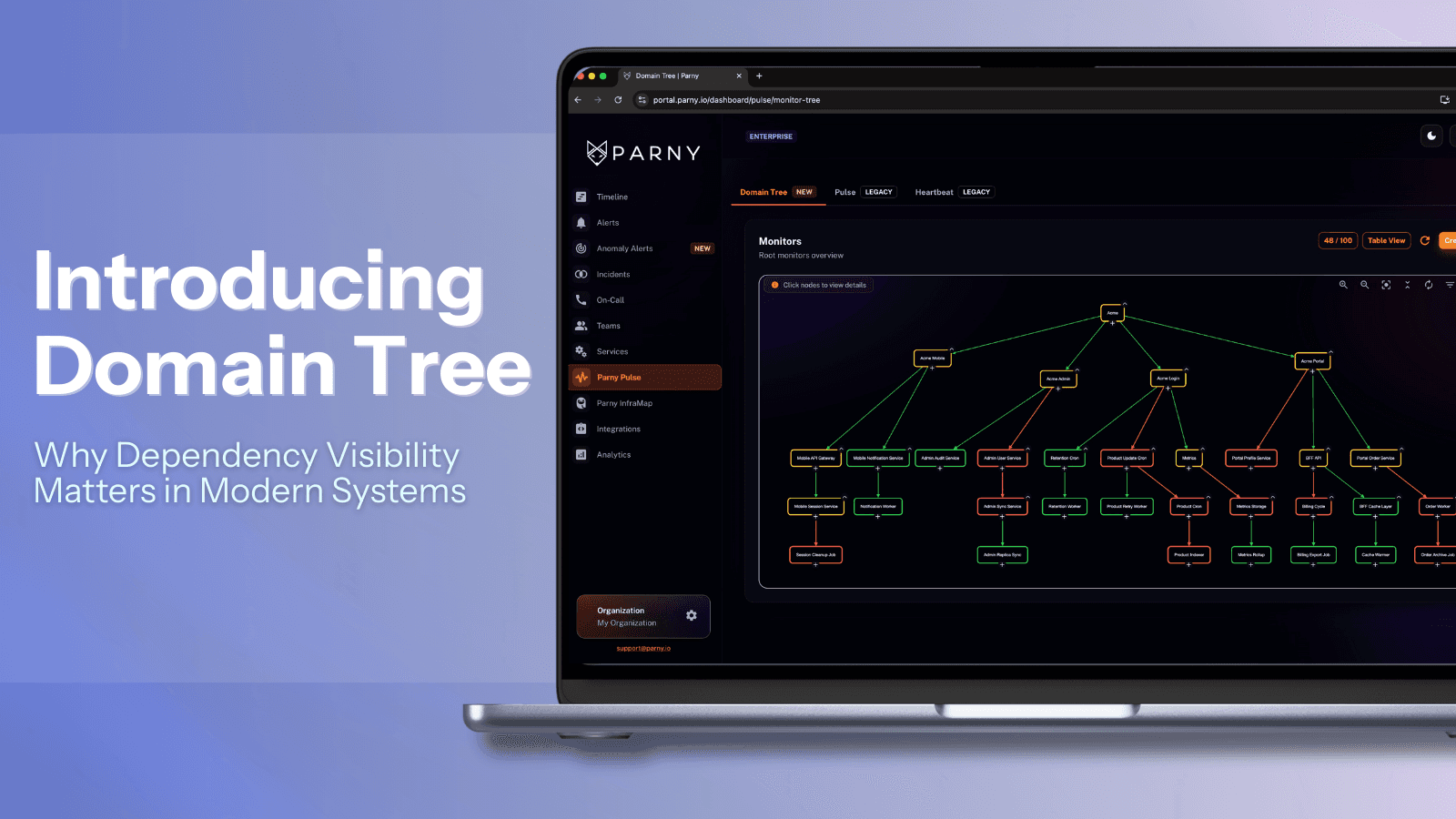
PagerDuty models service relationships through dependencies you define and maintain by hand. They're useful, but they reflect only what someone configured, and they describe a service model rather than your live infrastructure. PagerDuty doesn't discover your environment and build a real-time map on its own.
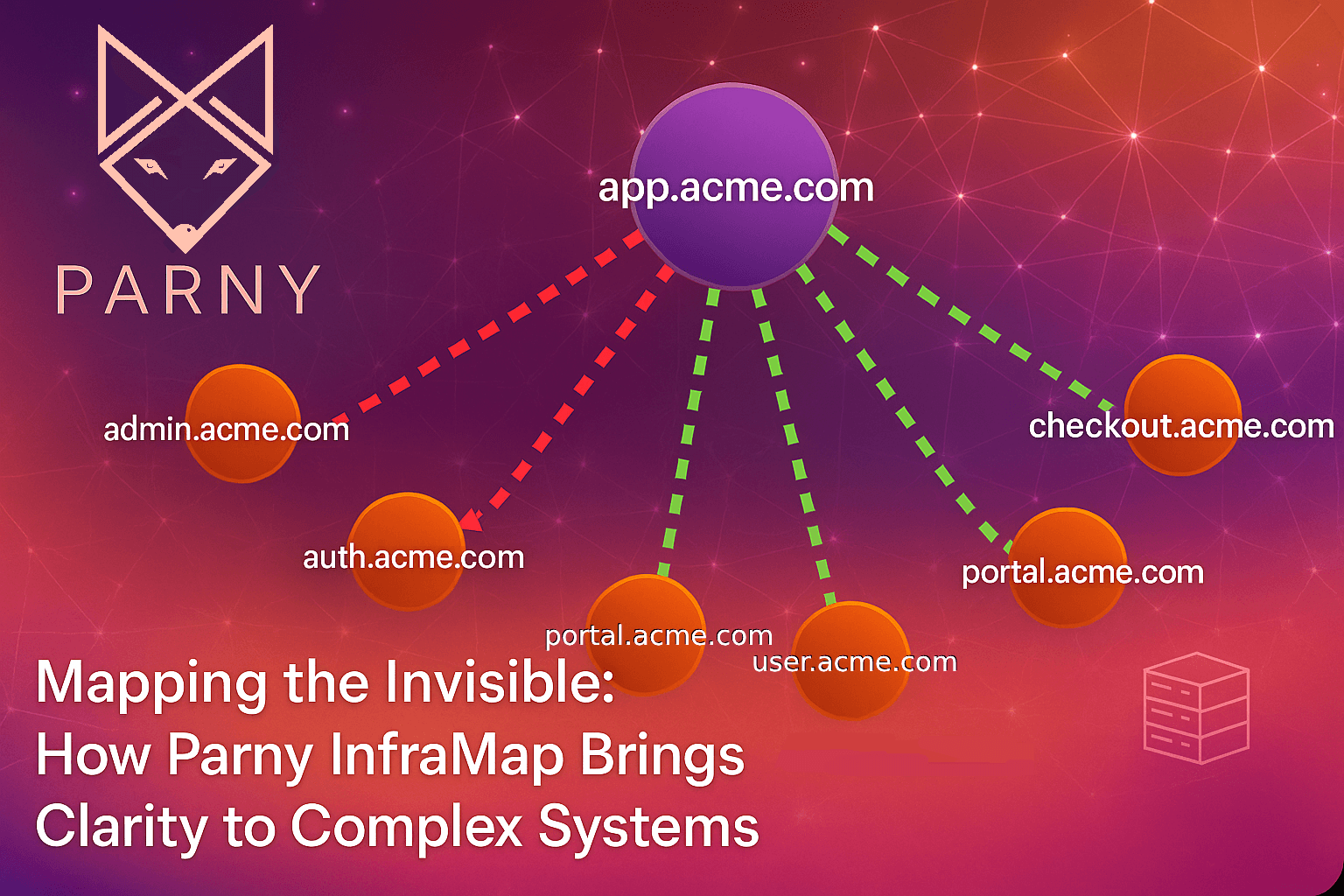
Parny does. Its Infrastructure Visibility discovers and maps, automatically and in real time, your servers, services, hosts, pods, containers, resources, ports, protocols and their upstream and downstream dependencies. Parny AI reasons over that live graph during an incident, so the map isn't a diagram off to the side. It drives the root cause assessment, impact analysis, affected-services view, blast radius and health assessment.
3. AIOps and incident diagnosis
PagerDuty's AIOps is a separate product, licensed per accepted event and priced by consumption from $699/mo. It's good at cutting noise, grouping related alerts and correlating changes. But that's correlation. It connects signals without telling you the underlying infrastructure cause.
Parny AI is built for that diagnosis and included in Premium on-call. Its anomaly detection is continuous and built on Random Cut Forest, an unsupervised algorithm for spotting anomalous points in streaming data, and it reasons over the live dependency graph, combining your existing alerts with Parny's own telemetry, service and resource health, and recent behavior. The output isn't one more grouped alert. It's decision-ready context:
Root Cause Assessment: the component, dependency or signal to investigate first.
First Place to Look: the specific service, host, container or database that needs attention now.
Impact Analysis, Affected Services and Blast Radius: what's hit, what's next, and how it travels through dependencies.
Health Assessment: the state of the relevant services, hosts, containers and resource pools.
Incident Summary: scattered alerts and dependency behavior turned into a structured explanation.
Action Plan and Prioritized Next Actions: infrastructure-specific steps for the situation at hand.
Ask Parny AI: plain-language investigation, from "what should we look at first" to "what changed before this."
This is decision support, not guaranteed remediation. Parny isn't an AI SRE and doesn't claim to resolve incidents on its own. It hands engineers stronger evidence and a prioritized path, not a promised fix.
4. Built-in monitoring and your existing stack
PagerDuty has no monitoring of its own; it routes in alerts from the tools you already run. Parny does both. It ships agent-based built-in monitoring for infrastructure metrics like CPU, memory and disk, plus database monitoring with slow- and anomalous-query detection, all anomaly-alerted. And it still plugs into Datadog, Prometheus, Grafana, Zabbix, CloudWatch, Dynatrace, New Relic, AppDynamics, Elasticsearch, Sentry and the rest, sitting above them as the SRE intelligence layer.
To be clear on scope, Parny adds native infrastructure and database monitoring but isn't a replacement for your APM, logs or traces. Your monitoring says something changed. Parny explains what that change means and what to do about it.
5. Integrations
On raw breadth, PagerDuty wins and it isn't close: 750+ integrations, the widest catalog on the market, and the safer bet for unusual, legacy or specialized tools. Parny's catalog is smaller but growing, covering the tools most teams actually run across monitoring and observability, cloud, APM, log management, error tracking, security, ITSM and ticketing, CI/CD, collaboration, plus webhooks and APIs.
The number alone shouldn't decide it. List what has to work on day one and check it against both. If your stack is exotic, PagerDuty's breadth is the reason to lean its way. If your tools are already covered, the question becomes what each platform does with those signals once they're connected.
6. Pricing: seats plus assets, not a stack of SKUs
Parny prices on two axes. The plan is billed per user: Freemium free, Basic $16/user/mo, Premium $32/user/mo, Enterprise custom, with 20% off yearly. That covers on-call and incident management, integrations, SMS and call handling, SocialOps, search, analytics, and from Premium up, Parny AI. Parny AI is billed per asset, where an asset is any VM, server or database it monitors. The rate starts around $18/asset and drops with volume automatically, paid plans include free assets before anything is billable, and the optional Parny Up Time Monitor add-on runs $20/mo for 50 sites or $35/mo for 100.
Two clean parts, and the second one is optional. A team that only wants paging pays for seats on Basic and stops there. A team that wants diagnosis moves to Premium and adds assets. What you never do is buy AIOps as a separate product: alert intelligence, grouping, noise reduction and root-cause diagnosis are part of the plan. That's the contrast with PagerDuty, where paging is the base and AIOps is its own consumption-priced line from $699/mo, on top of the $89 status-page add-on.
A 50-engineer example: on Premium at $32/user, seats come to $1,600/mo, and if you monitor only a handful of assets they fall inside the free allowance, so Parny AI stays near $0. The equivalent PagerDuty stack (seats plus the $89 status page plus the $699 AIOps add-on) runs about $2,838/mo, roughly $1,238/mo apart at list prices. Treat that as an illustration, not a promise: monitor many assets and Parny AI adds cost (PagerDuty's per-event AIOps climbs too), and enterprise discounts of 20–60% reshape both sides. The point is that Parny's bill has two predictable parts, with the capability that diagnoses your incident inside the plan.
Where Parny wins
AIOps is included, not an add-on. No separate consumption SKU from $699/mo.
On-call stands on its own. Parny Shift smart scheduling and Swap, On-Call Rules and multi-level Escalation Policies, Call/SMS/Push/Email notifications (Slack and Teams via integrations), a live Timeline, and a full who-was-notified record with response Analytics available as a straight on-call plan if that's all you need.
The topology is live and discovered for you. Service Discovery and InfraMap map servers, services, pods and dependencies in real time.
Monitoring is built in. Agent-based infrastructure and database monitoring provide operational visibility. Parny AI uses supported alert and infrastructure context for investigation; DB Agent data is not currently an input to Parny AI.
Diagnosis, not just correlation. RCF-based detection with Root Cause Assessment, Impact Analysis, Affected Services and Blast Radius on the first alert.
The bill has two clean parts. A per-user plan plus per-asset Parny AI, roughly $1,238/mo below the equivalent PagerDuty stack for a 50-engineer team monitoring few assets, at list prices.
Where PagerDuty wins
We publish this because a comparison you can't trust isn't worth much.
750+ integrations against our growing catalog. If you run an exotic stack, check ours first.
Fifteen years of enterprise hardening: compliance certifications and support SLAs at a scale we're still building toward.
If you only need basic paging and nothing else, PagerDuty's Professional tier is a proven choice.
If those matter more than everything above, PagerDuty is probably the right tool for you today.
Migrating off Opsgenie, or comparing PagerDuty because Opsgenie is shutting down?
Atlassian ends Opsgenie support on April 5, 2027, and unmigrated data goes with it. Parny’s Opsgenie migration imports your users, teams, integrations and on-call schedules; rotations, escalation policies and notification settings are configured and validated with your team. Because the plan is per user with Parny AI per asset, you'll know your new bill before you start. If your team wants a like-for-like on-call replacement first, Basic does that; the AIOps layer is there when you're ready for it.
How to actually test both
A feature checklist won't settle it. Run both against the same real incident from your own environment and watch:
What does the responder get with the very first alert, and can it name the first place to look?
How accurately does it map your services and dependencies, and does infrastructure health feed the diagnosis?
Are the recommended actions specific to your environment, and how do they change as new signals land?
Which capabilities need an extra product, and what's the full cost for your actual users, assets and volume?
The better platform is the one that shrinks the distance between the first signal and the right call.
The bottom line
PagerDuty is still a credible, mature choice for on-call, enterprise incident response and the broadest integration coverage you can get. Parny is built on a different bet: that paging the right person isn't the finish line. By combining your signals with its own built-in monitoring, an automatically-discovered topology and a live service-dependency graph, it helps teams see root cause, impact, affected services, blast radius, health and the next action in one place, with AIOps and status pages included rather than sold separately.
So the choice isn't really PagerDuty versus Parny. It's between two models: a mature incident ecosystem you extend with separately-priced AIOps, or an AIOps platform where the intelligence is the product, priced as a per-user plan plus per-asset Parny AI. For PagerDuty, AIOps is the add-on. For Parny, it's the whole point. And if today you only need the paging half, you can start there and grow into the rest without changing tools.